
Work · With the Cal Poly Pomona Aerospace Engineering department
Turbine-Powered VTOL Platform
A VTOL airframe driven by twin JetCat P60 micro-turbines instead of electric rotors: over 13 kg of combined thrust and fixed-wing cruise speeds, while keeping multirotor agility for vertical take-off.
The problem
Electric multirotors trade endurance and payload for simplicity. Turbines offer both, but bring kerosene start sequencing, high-temperature structures and fuel-flow control that an electric flight stack has no concept of.
What I did
Integrated twin JetCat P60-SE turbines with a hybrid avionics stack: an ArduPilot VTOL flight controller extended with real-time fuel-flow PID.
Built the structure in high-temperature composites, carbon-fiber and Kevlar with ceramic thermal barriers, to survive exhaust adjacent to load-bearing members.
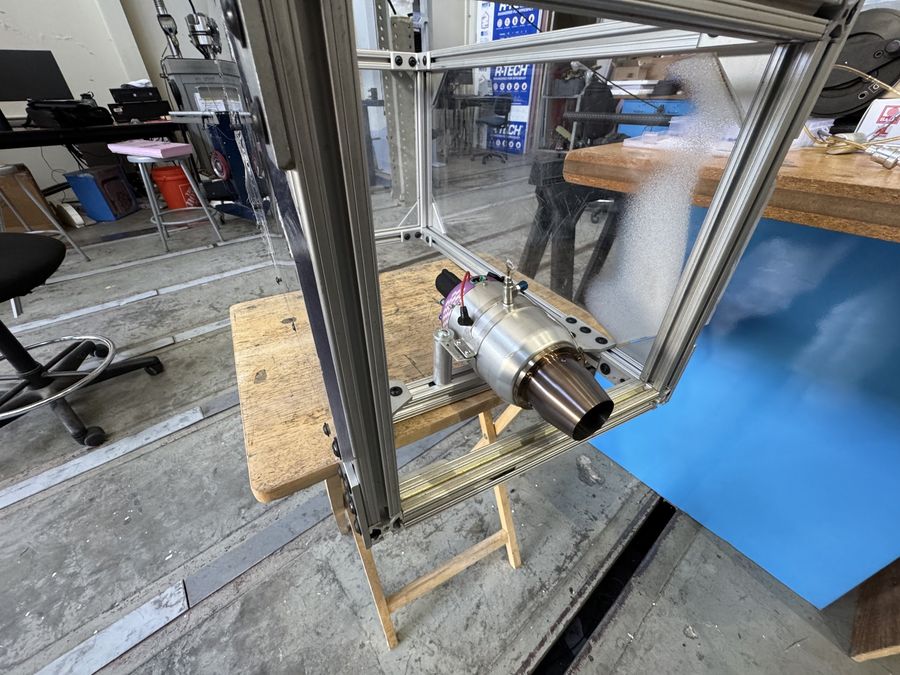
Sized the aerodynamics with XFOIL and AVL, checked with Ansys Fluent CFD, then validated on a thrust stand rather than trusting the model.
Result
A long-range, high-payload platform suited to rapid aerial mapping, heavy-lift logistics and propulsion research, with on-board data logging for post-flight analysis.
From the report
Bench photographs and measured data from the project's own report.