
Work · NASA MINDS · RSCL, Cal Poly Pomona
Solar-Electric Fixed-Wing Endurance Platform
A fixed-wing UAV whose wing-mounted array charges the flight pack in the air, pushing endurance past what the battery alone would give.
The problem
A solar array on a small airframe delivers a trickle, not a flight current. The engineering is not in the cells — it is in getting that trickle into a pack that is simultaneously delivering propulsion current, without the two paths fighting each other.
Everything added to capture energy also costs mass and drag, so an array that does not pay for its own weight makes endurance worse rather than better.
What I did
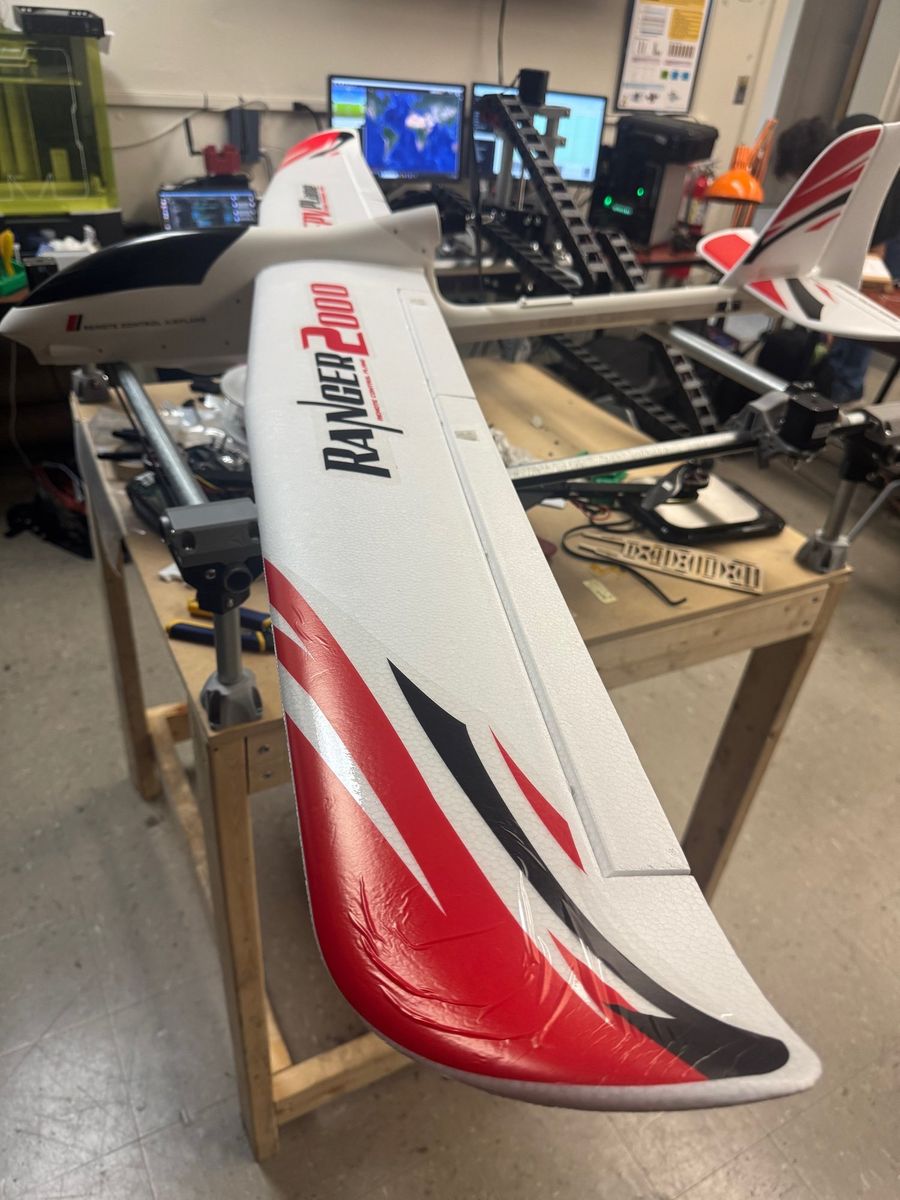
A Volantex Ranger 2000 airframe provides a known, high-lift platform so the work could stay on the energy path rather than on aerodynamics.
A 10 A MPPT charge controller sits between the array and the pack, tracking the array through changing illumination as the aircraft banks and the sun angle moves — the condition where a fixed-voltage converter gives up most of its yield.
Propulsion is a Sunnysky X2212-9 driving the airframe, with the energy-management design aimed at stable power delivery and minimized conversion loss between array, pack and motor.
Result
The analysis produced the two figures that matter for sizing: a modeled endurance comparison putting solar-assisted flight well above battery-only, and a trade curve showing how added wing area buys generated power against the mass it costs — the point where more array stops paying for itself.
This one is honest about where it stopped. There is a complete energy-management architecture, component-level trade studies, and a built airframe with the charging path specified, but it was documented at design-review stage and never carried through to a measured endurance figure in flight. Treat it as sizing and integration work backed by analysis, not by a flight test.
From the report
Bench photographs and measured data from the project's own report.