
Work · NASA MINDS 2024 and 2025 · Teams Kepler-452b and Gliese-581d · RSCL
Post-Quantum Telemetry for Spacecraft Links
Encrypting and signing a live vehicle telemetry link with lattice cryptography, on RISC-V compute small enough and cheap enough to fly, inside a millisecond budget.
The problem
Projections put RSA-2048 within hours of a quantum computer holding roughly 4000 logical qubits. Anything launched today with classical public-key crypto is exposed to harvest-now-decrypt-later: the traffic is recorded now and opened when the hardware exists.
Post-quantum schemes fix the mathematics and make everything else harder. Keys and signatures are substantially larger, the operations are heavier, and the budget is a few milliseconds on a board that runs on a handful of watts.
What I did
Two schemes were built against the same architecture so they could be compared honestly: CRYSTALS-Kyber512 for key encapsulation and CRYSTALS-Dilithium2 for digital signatures, each at the 128-bit post-quantum security level.
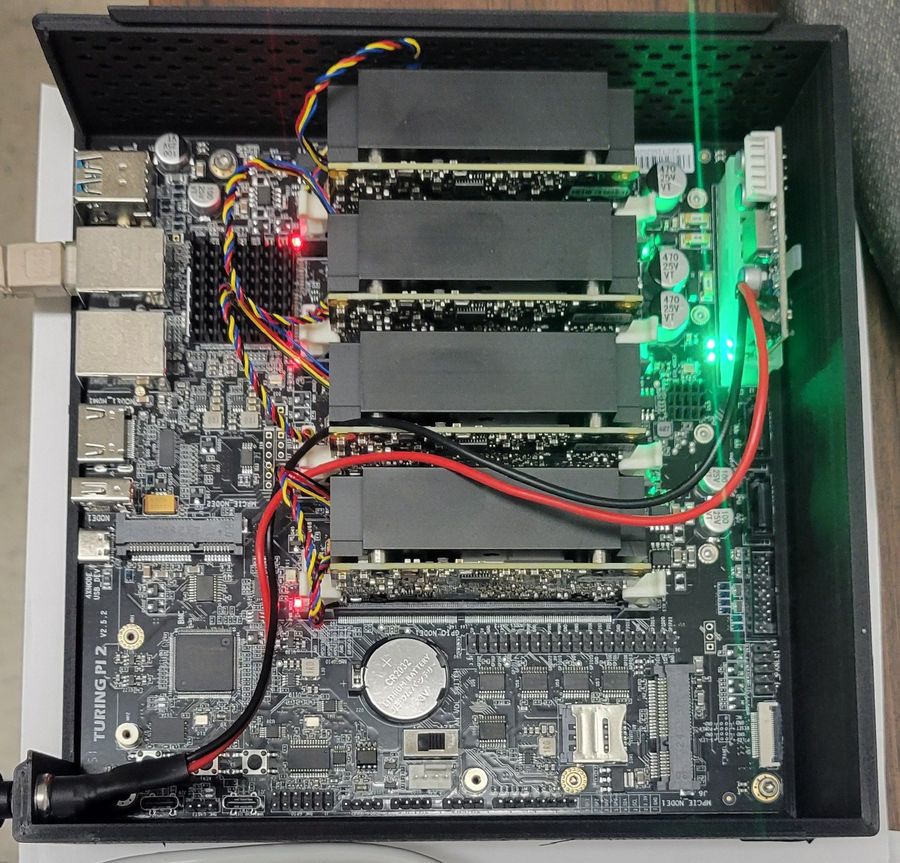
The work was split across the hardware the way a real vehicle would split it. TRK1 compute modules — RISC-V — on a Turing Pi 2.5 cluster act as the vehicle-side unit doing encapsulation and signing. Four Raspberry Pi Zero 2 W nodes on a ClusterHAT 2.5 act as the ground segment, distributing verification and decapsulation across nodes.
Signed and encrypted telemetry rides MAVLink, so the cryptography sits under the protocol the vehicle already speaks rather than replacing it.
Result
Kyber512 key encapsulation on the TRK1 modules averaged 6.7 ms, with peaks under 8 ms across every test case. Dilithium2 signing on the same hardware averaged 6.5 ms, peaks again under 8 ms.
On the ground segment, each Pi Zero 2 W node completed decapsulation and symmetric decryption — and, for the signature pipeline, verification — in under 4.2 ms on average. Figures are averages over 100 trials per configuration.
The conclusion the numbers support: post-quantum telemetry is affordable at these message rates on low-power, low-cost compute. The cryptography was not the bottleneck.
From the report
Bench photographs and measured data from the project's own report.