
Work · NASA MINDS · Team Kepler-1708b and successor build · RSCL
Encrypted Command Link for a Ground/Air Robot Pair
Ascon protecting the command channel between a ground vehicle and an aircraft, with an encrypted heartbeat that fails both vehicles safe the moment the link dies.
The problem
A robot taking commands over a radio link in a remote environment needs those commands authenticated — an unauthenticated command channel is an actuator anyone nearby can drive. But a full cryptographic stack costs latency the control loop does not have to give.
The subtler failure is silence. If the link drops and nothing notices, a vehicle keeps executing whatever it was last told, which for an aircraft is the worst possible default.
What I did
Ascon — the NIST lightweight standard, built on a sponge construction — protects the channel, with a hybrid RSA and ECDH exchange establishing the session. Ascon was chosen over a heavier cipher specifically because the per-message cost had to disappear inside the control loop.
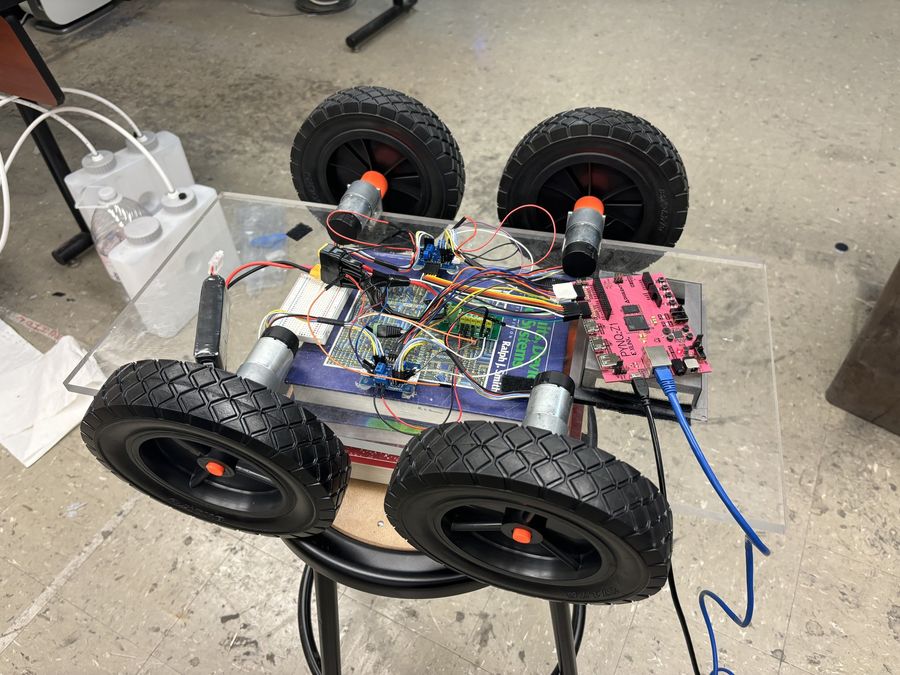
The ground vehicle runs NASA's F Prime (F´) flight-software framework on a PYNQ board, owning encryption and fail-safe signaling, while a Raspberry Pi drives the local actuators. The aircraft mirrors it: a Raspberry Pi decrypts in front of a Pixhawk running ArduPilot, so nothing reaches the flight controller unauthenticated.
Both sides exchange an encrypted "chirp" heartbeat over a dedicated Wi-Fi network. Losing the chirp is itself the fail-safe trigger, which turns a silent link failure into an immediate, detectable event. Power draw was profiled with a Nordic Power Profiler Kit II across motor duty cycles.
Result
At the top of the tested range — 1000-byte messages — encryption averaged under 800 µs and decryption under 900 µs. Typical command packets and sensor updates are a few hundred bytes, so the real-world cost is comfortably sub-millisecond and invisible to the control loop.
Power profiling produced a genuine anomaly worth reporting: current draw at 100 percent motor duty came in below both 50 and 75 percent. Reverse-engineering the motors traced it to a compromised motor rather than a measurement error — the kind of finding that only shows up when you instrument the thing properly.
A stand-alone terrain classifier trained over ten epochs separated safe surfaces such as soil and sand from hazardous ones such as large rocks, giving the ground vehicle a basis for refusing a commanded path.
From the report
Bench photographs and measured data from the project's own report.