
Work · NASA MINDS · Team Gliese-514b · RSCL, Cal Poly Pomona
Air-and-Ground Hybrid Vehicle
One vehicle that drives across terrain it can cross and flies over terrain it cannot, with both propulsion systems sharing a single airframe, battery and controller.
The problem
A ground vehicle has the endurance and is stopped by a boulder field. An aircraft crosses anything and burns its battery doing it. Carrying both means two propulsion systems competing for the same mass and power budget, and every gram spent on tracks is a gram of flight endurance lost.
The two modes also want different things from the controller: a tracked drive wants torque and slip control, a quadrotor wants attitude at high rate. Both have to live behind one flight stack.
What I did
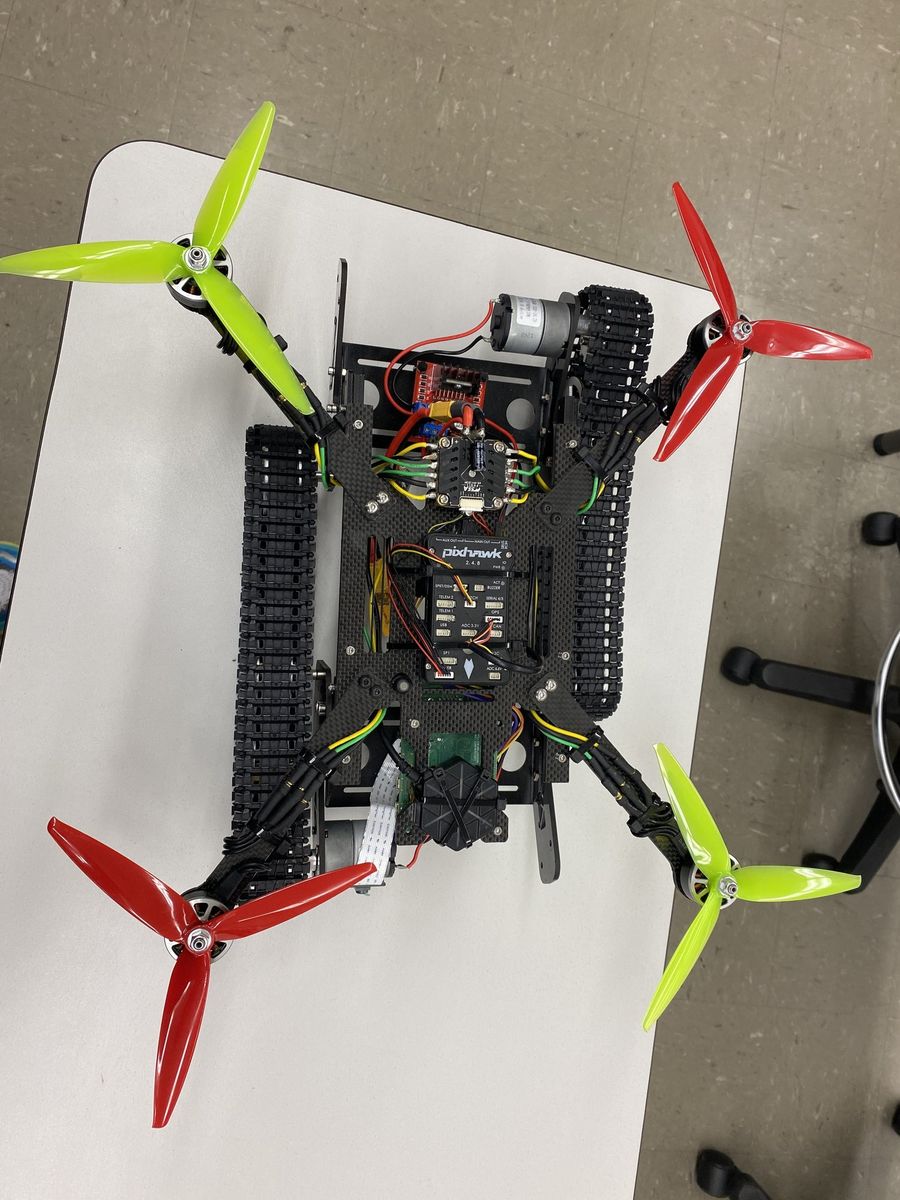
A carbon-fiber chassis carries a tracked ground drive and four rotor arms on the same plate, keeping the mass centered between the two modes rather than optimizing for either.
A Pixhawk 2.4.8 running a standard flight stack handles attitude and mission, configured and validated through Mission Planner, with manual control verified over RC before autonomous modes were enabled. L298N drivers run the ground drive; a 4-in-1 ESC runs the rotors.
Motor, ESC, propeller and battery selection were each taken through evaluation rather than picked from a build list, because the hybrid mass fraction leaves much less margin than a pure quadcopter would.
Result
The most useful result was a failure. Within thirty seconds of a control test the TMotor F55A Pro II 4-in-1 ESC emitted smoke and failed outright.
Root-causing it pointed at the power distribution design and ESC configuration rather than a bad part: the current limits had been set for the aircraft in isolation, not for a vehicle carrying tracked drive mass. The fix was larger propellers, a revised electrical design with correct current limits, and added cooling.
That is the honest state of the build — a flying, driving airframe whose first integrated test found a real electrical design error, and a design revision that addresses the cause rather than the symptom.
From the report
Bench photographs and measured data from the project's own report.