
Work · NASA MINDS 2024 and 2025 · Team Kepler-22b · RSCL, Cal Poly Pomona
Airborne Observatory with On-Board Plate Solving
A UAV that lifts a stabilized telescope clear of the worst of the atmosphere and works out what it is looking at on board, without needing a ground station in the loop.
The problem
Ground telescopes fight two things they cannot move away from: atmospheric distortion and light pollution. Flying the instrument solves both, and creates a harder problem in exchange — every meter of drift and every degree of attitude change smears an exposure, and the platform is now a vehicle that moves in all six degrees of freedom.
The obvious answer is to stream frames to a ground station and solve them there. That makes the radio link a single point of failure for the entire mission, which is exactly the dependency a lunar-surface analogue is supposed to avoid.
What I did
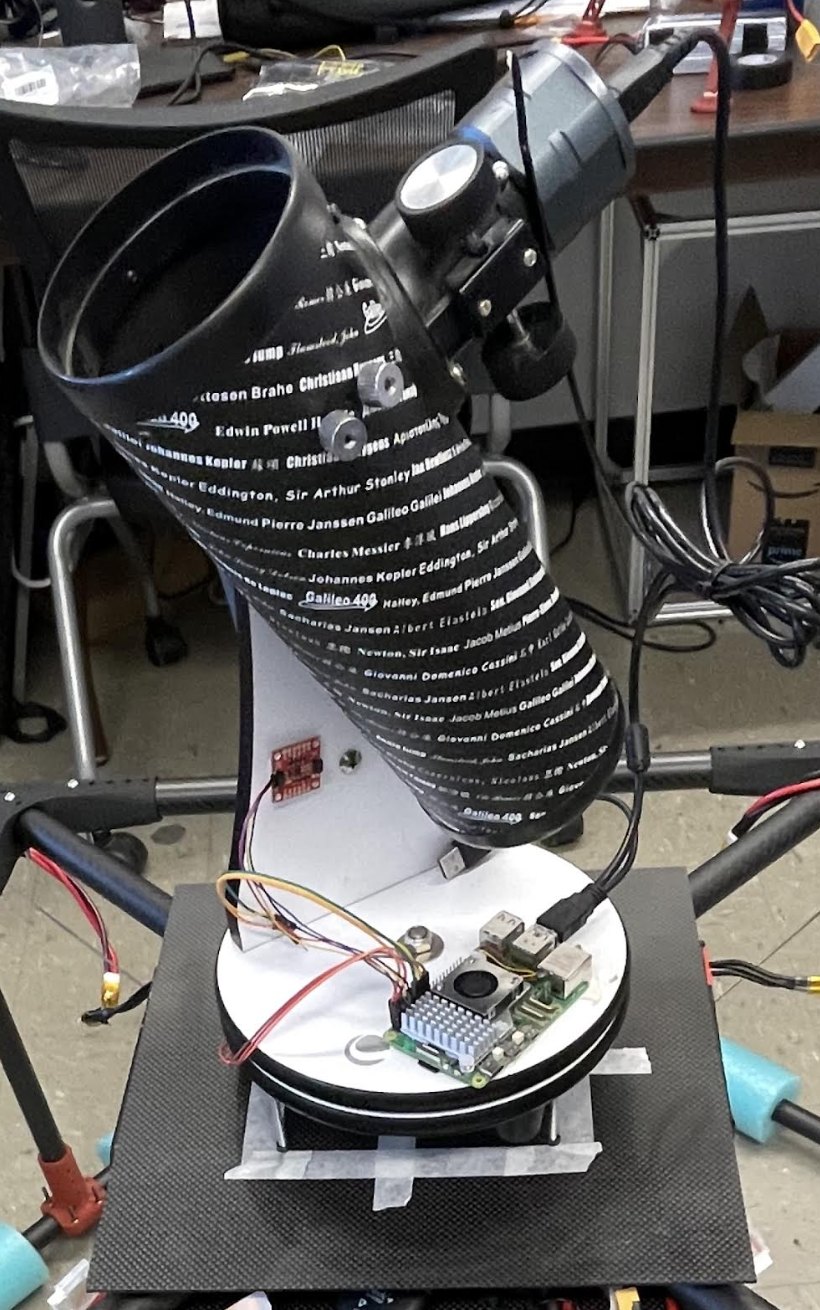
The airframe is carbon-fiber rod and 3D-printed structure, sized to carry the optics rather than adapted from a stock frame. A gimbal and gyroscopic stabilization stage carries an SVBONY SV305C camera and holds the optical axis steady enough to expose against a moving platform.
Identification runs on the vehicle. A Raspberry Pi 5 performs plate solving with Astrometry.net against star catalogues, so the aircraft returns celestial coordinates rather than raw frames. The earlier 2024 build approached the same problem with YOLOv5 and OpenCV for object detection alongside SkyField for ephemeris; the 2025 build replaced detection with plate solving because matching a whole star field is far more robust than detecting objects in it.
Trade studies drove the component choices — carbon fiber and printed structure for stiffness per gram, T-Motor 30x12 propellers for the cost/performance balance, and the Pi 5 as the single-board computer that could actually carry the solver.
Result
Astrometry matched star patterns in over 95 percent of captured images, including under light pollution and atmospheric distortion, and returned precise right ascension and declination for the field.
Solve time stayed under 10 seconds per image on the Raspberry Pi 5 — inside the real-time budget the project set, on a board chosen for what an aircraft can carry rather than for compute headroom.
The gimbal and gyroscopic stage held the camera steady enough for the solver to work against a flying platform, which was the load-bearing assumption of the whole design.
From the report
Bench photographs and measured data from the project's own report.