
Work · Sole-authored study · Cal Poly Pomona
40 mm EDF Thrust and Thermal Characterization
A thrust-stand study of a 40 mm electric ducted fan across 2S, 3S and 4S packs — measuring what the unit actually delivers over a full discharge, and what it costs thermally.
The problem
Ducted fan vendors quote a peak thrust at a single voltage, measured at the start of a fresh pack. A designer sizing an aircraft needs something else entirely: thrust across a whole discharge, thrust per watt, and the thermal load that comes with the configuration that looks best on paper.
Without that, cell-count selection is guesswork, and the failure shows up late — as a vehicle that hovers at handover and cannot hold altitude at the end of a mission.
What I did
An instrumented thrust stand logged bus voltage, current, RPM, thrust and temperature continuously through a complete discharge, rather than sampling at a set point.
The full run was repeated for 2S, 3S and 4S battery configurations so the comparison covers the whole discharge curve, including the sag at the end where sizing decisions actually bite.
Efficiency was reported in watts per gram of thrust, which is the number that lets a configuration be compared against a mass budget instead of against another datasheet.
Result
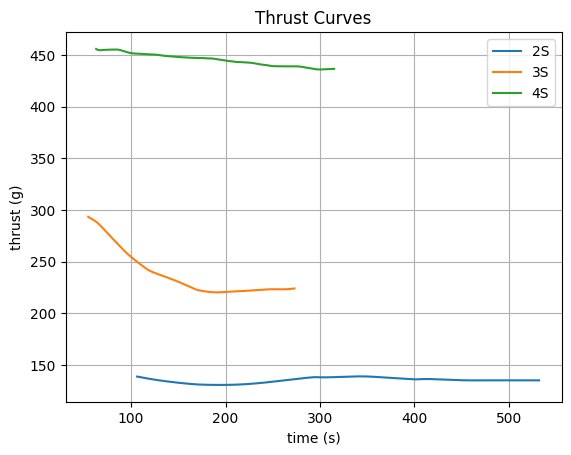
The 4S configuration produced the highest thrust — roughly 450 g, holding within a few percent across the run — and carried the highest thermal load, enough that it needs deliberate cooling rather than incidental airflow.
The 3S configuration dropped noticeably early, from about 290 g to roughly 225 g, then held steady. The 2S configuration was the most stable and the weakest, sitting near 135 g throughout, with the most manageable temperatures.
Across every configuration, efficiency in W/g got worse as voltage rose: more thrust, less thrust per watt. That trade — and not the peak number — is the useful output, and it makes cell-count selection a decision with evidence behind it.
From the report
Bench photographs and measured data from the project's own report.