
Work · NASA MINDS · Team Kepler-138b · RSCL, Cal Poly Pomona
Electromagnetic Payload Launcher
A pulse-power launcher that throws a small glider or instrument package to terrain a rover cannot reach, using a capacitor bank rather than a propellant charge.
The problem
Getting a payload across broken terrain is a delivery problem before it is a robotics problem. Electromagnetic launch trades a chemical charge for stored electrical energy, which means storing a large amount of it and dumping it in milliseconds.
Doing that repeatably is the harder half: the rails, bearings and structure have to survive the discharge and stay in alignment across shots, or the second launch is nothing like the first.
What I did
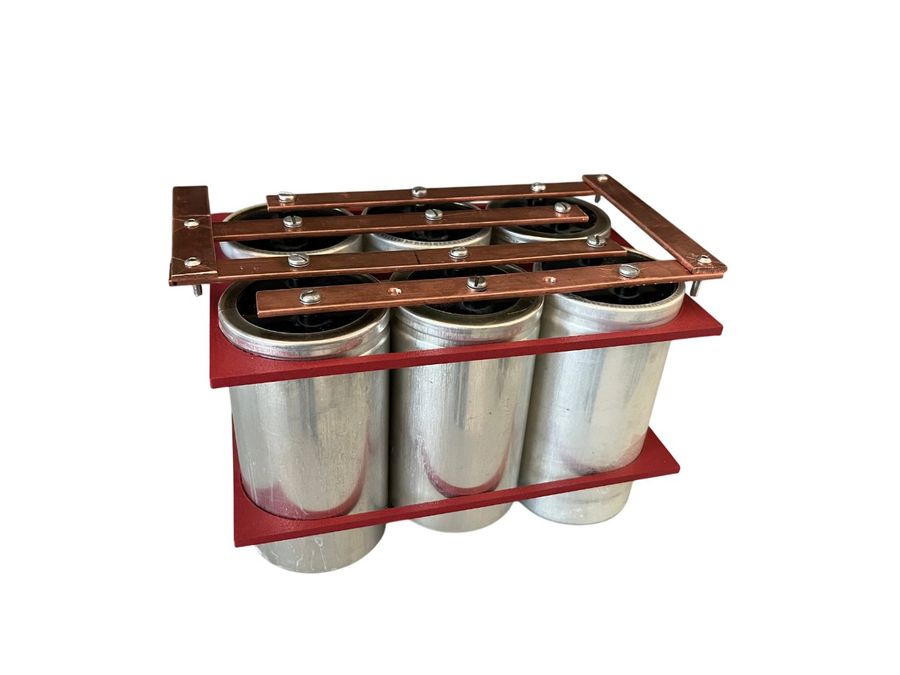
Energy storage is a pulse-forming network built from 2400 µF capacitors in parallel, joined by copper bus bars sized for the discharge current rather than the average.
The launch axis runs on a linear rail and bearing carriage mounted to 80/20 aluminum extrusion, with 3D-printed plane-mount holders, brake end caps and insulating connectors for the copper rail — the insulating parts being the ones that decide whether the structure survives.
An STM32 Nucleo-64 sequences the discharge and safety interlocks. Component selection went through an analytic hierarchy decision matrix, and the assembled PFN module was characterized on an LCR-6002 meter before energizing.
Result
The linear rail and bearing system was fully assembled and aligned, and after lubrication produced consistent motion along the rail, confirming the mechanical integrity of both the bearing blocks and the supporting structure.
The printed parts fitted the extrusion framework securely, with dimensional checks showing minimal post-processing needed — which matters for a design meant to be rebuilt and iterated.
The PFN module was assembled with its capacitors and bus bars and taken through initial low-voltage discharge testing. The build reached validated subsystems and a characterized pulse network rather than a full-energy launch.
From the report
Bench photographs and measured data from the project's own report.