
Work · NASA MINDS competition
Autonomous Aerial Docking and Recharge
NASA MINDS 2024 - Finalist
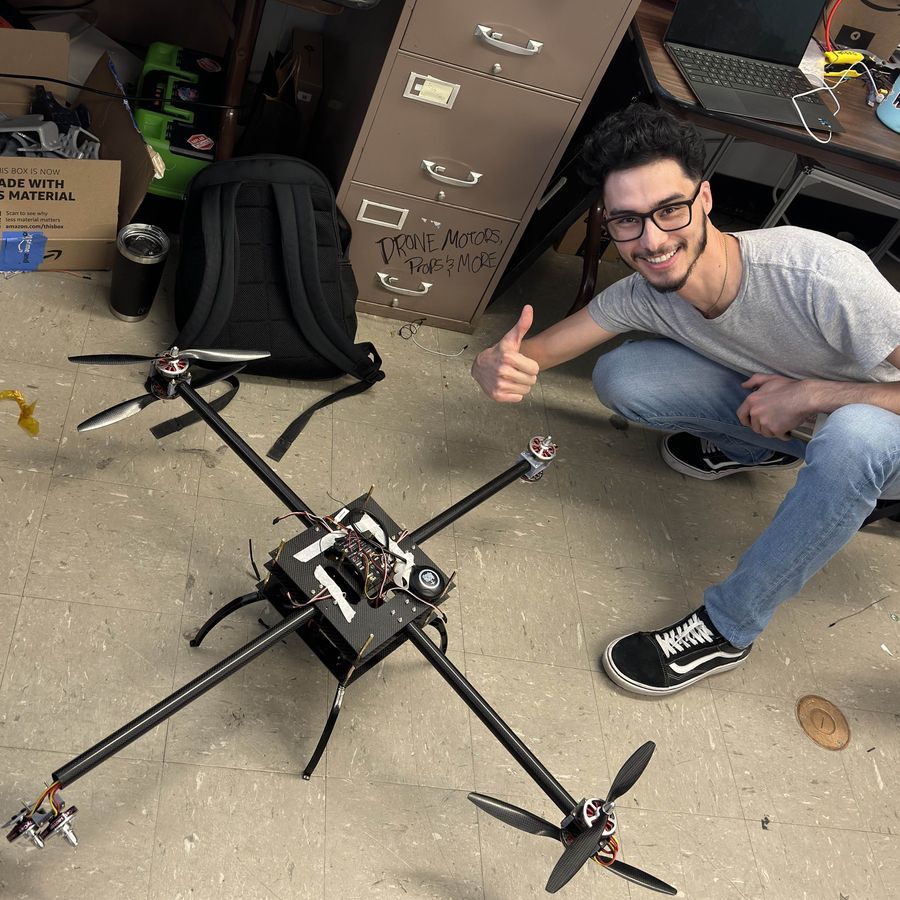
A heavy-lift carrier UAV acting as an airborne charging hub and data relay, letting micro-drones dock in flight to recharge, offload sensor data and borrow GPU cycles.
The problem
Micro-drone endurance is measured in minutes, which caps any mission built on them. Landing to recharge surrenders the position and the time.
Docking two aircraft in flight is a precision control problem where GPS is nowhere near accurate enough.
What I did
Built a vision-based docking system using OpenCV and visual-servo PID loops, closing the loop on what the camera sees instead of on position estimates.
Coordinated the swarm over ArduPilot and MAVLink with a 5 GHz Wi-Fi mesh plus LoRa telemetry, so control and bulk data used appropriate links.
Ran distributed compute across Jetson Xavier NX and Orin Nano nodes under k3s, turning the docked swarm into a compute cluster rather than just a charging stop.
Result
Mission endurance extended from minutes to hours, with the swarm doubling as a distributed compute and relay platform. Finalist at NASA MINDS 2024.
From the report
Bench photographs and measured data from the project's own report.